Ratling
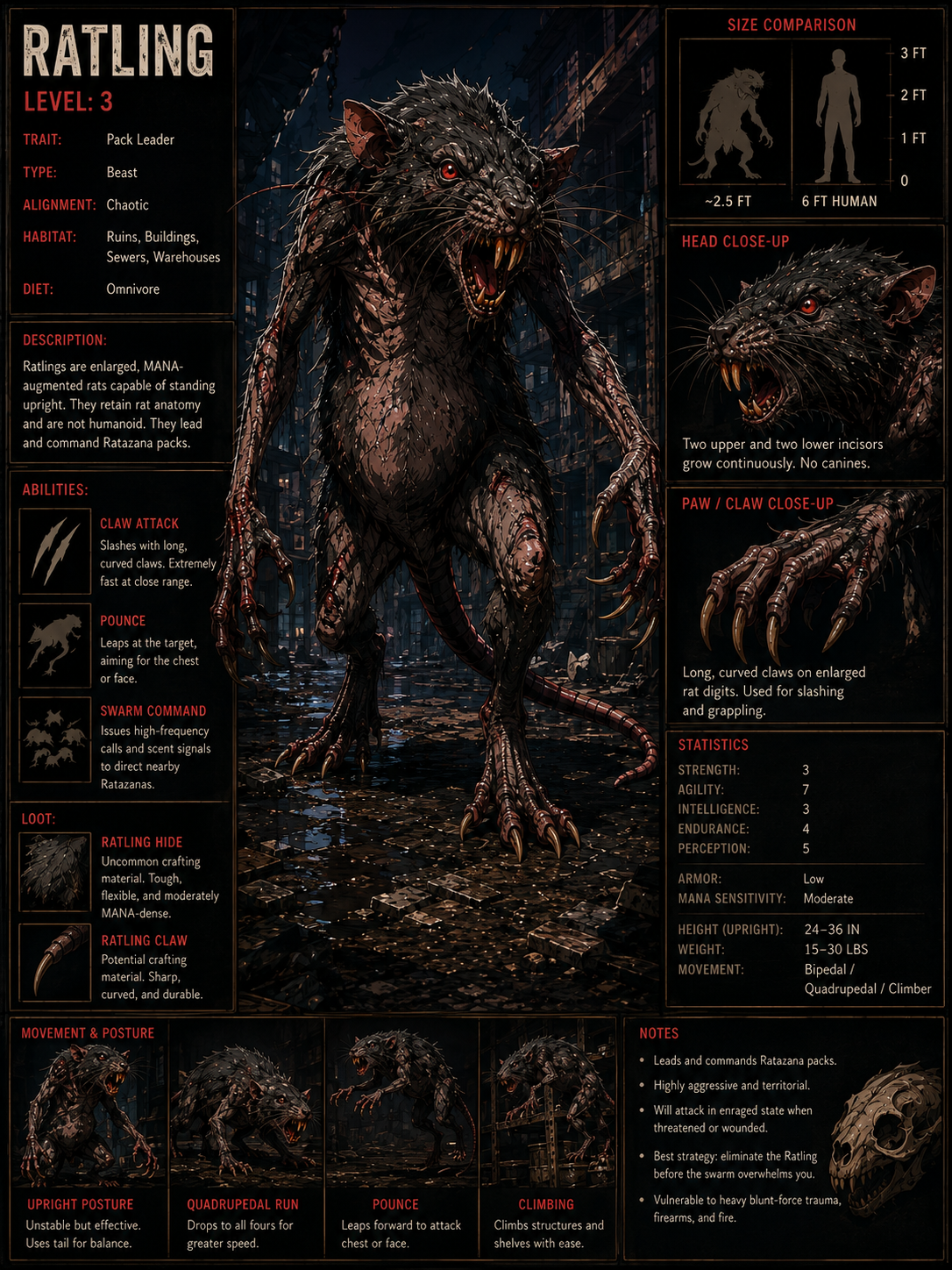
Level: 3
Type: Beast
Classification: Pack Leader / Evolved Rodent
Nature: Biological / MANA-Augmented
Status: Active
Threat Level: Moderate Individually / High with a Ratazana Swarm
It is not a small person with a rat’s head.
It is a rat forced into a shape it was never meant to hold.
Overview
Ratlings are larger, more aggressive rodent creatures associated with groups of Ratazanas.
They retain the biological foundation of a rat but possess a body capable of temporarily maintaining an upright posture. This change does not make them humanlike.
Their anatomy remains unmistakably rodent.
A Ratling stands on enlarged hind legs, using its long tail for balance while its narrow upper body leans forward. Its spine remains curved, its shoulders remain hunched, and its head projects in front of the torso rather than resting naturally above it.
The creature can drop onto all four limbs when moving at high speed.
Ratlings appear to direct or influence nearby Ratazanas. Their presence makes swarms more coordinated, aggressive, and difficult to scatter.
Whether Ratlings are evolved Ratazanas, a distinct biological caste, or separate creatures remains unknown.
Appearance
Ratlings resemble oversized black or dark-gray rats whose bodies have been altered to permit unstable bipedal movement.
They should not resemble small humanoids.
Known characteristics include:
- Height between two and three feet while upright
- Strongly curved spine
- Forward-leaning posture
- Narrow upper torso
- Rounded or pear-shaped abdomen
- Visible rodent ribcage beneath sparse fur
- No human pectoral muscles
- No defined abdominal muscles
- Narrow, hunched shoulders
- Short neck
- Head projecting forward from the body
- Long forelimbs that hang close to the ground
- Enlarged rat forepaws capable of grasping
- Long curved claws extending from recognizable rodent digits
- Oversized hind legs
- Long rat feet
- Dry, coarse black or dark-gray fur
- Sparse fur over the chest, abdomen, joints, and damaged areas
- Gray-pink rat skin beneath exposed sections
- Rounded ears capable of folding backward
- Long whiskers
- Red-reflective or dark eyes
- Two upper and two lower orange-yellow incisors
- No canine teeth
- No rows of predator fangs
- Long hairless tail used for balance
The creature’s upright posture should appear uncomfortable and unnatural.
It does not stand like a human.
It balances like a rat that learned how to remain vertical long enough to use its forelimbs as weapons.
Size
Upright Height: 24–36 inches
Typical Hunched Height: 18–26 inches
Estimated Weight: 15–30 pounds
Movement: Bipedal, quadrupedal, climbing
Body Structure: Modified rodent anatomy
Ratlings are small compared with most monsters.
Their danger comes from speed, aggression, claws, and the ability to move between upright and quadrupedal postures without warning.
Their size allows them to:
- Move beneath shelving
- Climb industrial storage
- Leap toward a human torso
- Hide behind debris
- Navigate damaged buildings
- Attack from elevated positions
MANA Profile
MANA: Metaphysical Augmentation through Natural Aether
MANA Density: Moderate
Primary Expression: Biological Augmentation
Secondary Expressions: Coordination, Aggression, Mobility
Observed Behavior: Territorial / Enraged / Pack-Oriented
MANA appears to have altered the Ratling more significantly than the Ratazana.
Observed changes may include:
- Increased body size
- Restructured hips and hind legs
- Increased spinal flexibility
- Stronger forelimbs
- Enlarged claws
- Increased intelligence
- Increased aggression
- Improved coordination with nearby Ratazanas
- Ability to alternate between upright and quadrupedal movement
The body remains biologically recognizable as a rat.
MANA has not transformed it into a humanoid.
It has modified the rat’s existing anatomy to create a more capable predator and pack leader.
Known System Information
Ratling
Level: 3
Status: Enraged
Skill: Claw Attack
Additional information may become available through observation, research, combat, increased levels, or expanded System access.
Estimated Attributes
| Attribute | Rating | |---|---:| | Strength | 3 | | Agility | 7 | | Intelligence | 3 | | Endurance | 4 | | Perception | 5 | | Armor | Low | | MANA Sensitivity | Moderate |
Traits
Pack Leader
Ratlings appear to direct nearby Ratazanas.
The exact method remains unknown.
Possible mechanisms include:
- High-frequency vocalization
- Scent signals
- Body language
- MANA-based communication
- Instinctive colony hierarchy
When a Ratling is present, nearby Ratazanas may display:
- Greater aggression
- Reduced fear
- Improved coordination
- Increased willingness to attack armed targets
- Coordinated flanking
- Coordinated retreat
- Protection of the Ratling
Killing or incapacitating the Ratling may cause the remaining swarm to flee.
Unstable Biped
The Ratling can remain upright but is not naturally balanced like a human.
Its long tail and oversized hind feet provide stability.
The creature may use its upright posture to:
- Slash with both forelimbs
- Reach higher targets
- Leap toward the torso or face
- Observe above obstacles
- Direct a swarm
When greater speed is needed, it drops onto all four limbs.
The transition is rapid and unpredictable.
Enraged
When wounded, threatened, or confronted inside its territory, the Ratling may enter an enraged state.
Observed effects may include:
- Increased attack frequency
- Reduced response to pain
- Increased willingness to remain in close combat
- Reduced defensive behavior
- Aggressive focus on a single target
Enrage increases danger but may make the creature less cautious.
Skill
Claw Attack
The Ratling attacks using one or both enlarged forepaws.
Its claws are longer and stronger than those of a Ratazana but remain attached to recognizable rat digits rather than human fingers.
The attack may be delivered as:
- A downward slash
- A lateral swipe
- Repeated alternating strikes
- A leaping attack
- A close-range grapple followed by clawing
Possible injuries include:
- Deep cuts
- Facial injuries
- Damaged tendons
- Bleeding
- Torn clothing
- Damage to exposed hands and arms
The Ratling’s speed may allow it to attack repeatedly before a target can create distance.
Additional Abilities
Pounce
The Ratling uses its oversized hind legs to leap toward a target.
It commonly aims for:
- Chest
- Shoulders
- Face
- Weapon arms
The attack may knock a target backward or force them to use a rifle or other object defensively.
Quadrupedal Rush
The Ratling drops onto all four limbs and moves with the speed and posture of an oversized rat.
This movement is faster than its upright advance and may be used to:
- Close distance
- Escape gunfire
- Move beneath obstacles
- Circle behind targets
- Enter narrow spaces
Swarm Command
The Ratling emits sounds or signals that influence nearby Ratazanas.
Possible commands include:
- Attack
- Surround
- Retreat
- Defend territory
- Focus on an injured target
The Ratling may not possess language or human-level planning.
Its control may be instinctive.
Behavior
Ratlings are territorial and highly aggressive.
They are commonly found near:
- Established Ratazana colonies
- Food storage
- Nesting areas
- Sheltered industrial locations
- Warehouses
- Hardware stores
- Sewers
- Abandoned buildings
They appear willing to confront threats that ordinary Ratazanas would avoid.
Ratlings may remain hidden while Ratazanas begin an attack, entering combat only after the swarm has divided the target’s attention.
If the swarm begins losing, the Ratling may emerge in an enraged state.
Combat Style
A Ratling relies on speed and pressure.
It does not stand in place and trade attacks.
Common combat behavior includes:
- Direct Ratazanas toward a target.
- Wait until the target’s attention is divided.
- Rush on all four limbs.
- Rise into a hunched upright posture.
- Pounce or slash repeatedly.
- Remain close enough to prevent safe gunfire from nearby allies.
- Retreat behind the swarm if seriously injured.
The Ratling’s greatest defense is proximity.
Once it reaches a human target, nearby allies may hesitate to fire.
Strengths
- Extremely fast
- Agile
- Capable of sudden posture changes
- Dangerous at close range
- Difficult to target while moving
- Can direct nearby Ratazanas
- Strong leaping ability
- Reduced response to pain while enraged
- Effective inside confined buildings
Weaknesses
Ratlings possess limited natural armor.
They remain vulnerable to:
- Firearms
- Blunt-force trauma
- Cutting weapons
- Fire
- Explosions
- Heavy impacts
- Coordinated attacks
- Open terrain
Their small body can be thrown significant distances by a sufficiently powerful strike.
Their unstable upright posture may also make them vulnerable to:
- Sweeping attacks
- Leg injuries
- Knockback
- Loss of balance
Combat Considerations
Recommended tactics include:
- Eliminate the Ratling before the swarm closes distance.
- Do not allow it to reach the center of a formation.
- Maintain clear lines of fire.
- Avoid firing when an ally is directly engaged.
- Use blunt-force attacks if the creature enters close range.
- Target the hind legs or tail to disrupt balance.
- Expect it to drop onto all four limbs.
- Watch elevated shelving and overhead structures.
- Do not assume the swarm is defeated until the Ratling is located.
If the Ratling is killed, observe nearby Ratazanas for immediate changes in behavior.
Potential Loot
Ratling Hide
Classification: Uncommon Crafting Material
Quality: Moderate
MANA Density: Moderate
Ratling Hide is thicker and more MANA-dense than ordinary Ratazana Hide.
Potential uses may include:
- Light armor
- Reinforced gloves
- Flexible joint protection
- Equipment wraps
- Grip material
- Crafting experiments
- MANA research
The material remains flexible despite its increased durability.
Ratling Claw
Classification: Potential Crafting Material
Status: Unconfirmed
Ratling claws may possess greater cutting strength than those of ordinary rodents.
Potential applications may include:
- Small blades
- Arrowheads
- Tool components
- Hooks
- Trap mechanisms
No Ratling Claw has been formally identified by the System.
This remains speculative.
First Recorded Encounter
The first documented Ratling was encountered inside an abandoned Harbor Freight during a supply mission.
The team was attacked by approximately fifty Ratazanas.
After the swarm suffered significant casualties, the remaining creatures fled following a loud screech.
The Ratling then entered the aisle.
It attacked Jose at close range, using repeated claw strikes and preventing the rest of the team from firing safely.
Darius found a demolition sledgehammer nearby.
When the Ratling attacked again, Darius struck it in midair.
The creature crossed the aisle and hit a wall.
It remained standing briefly before collapsing.
Darius later kept the hammer.
Research Questions
- Are Ratlings evolved Ratazanas?
- Is Level 3 an evolution threshold for this species?
- Can any Ratazana become a Ratling?
- Are Ratlings born separately?
- How do Ratlings control swarms?
- Does killing a Ratling always cause nearby Ratazanas to flee?
- How intelligent are they?
- Can they use simple tools?
- Can they gain additional levels?
- What form might appear beyond Level 3?
- Are larger colonies controlled by stronger rodent forms?
- Does MANA reshape their skeleton gradually or suddenly?
Narrative Role
The Ratling demonstrates that familiar animals can develop hierarchy, specialization, and new body structures under MANA augmentation.
The Ratazana is a larger, more coordinated rat.
The Ratling is what happens when that same biological pattern is pushed toward leadership, aggression, and close-range combat.
It is not a humanoid rat.
It is a rat that has become capable of standing long enough to kill like one.
Lore Notes
The Ratling must retain rodent anatomy.
It should not possess:
- A human chest
- Pectoral muscles
- Defined abdominal muscles
- A narrow human waist
- Human shoulders
- Human hands
- Human feet
- A fully upright spine
- Human facial structure
- Canine teeth
- Rows of fangs
Its posture should remain hunched and unstable.
Its abdomen should be rounded.
Its chest should be narrow.
Its long forelimbs should hang near the ground.
Its head should project forward.
Even while upright, every part of the creature should communicate one fact:
It is still a rat.
Quote
The creature stood upright on two powerful hind legs.
Not like a person.
Its spine curved beneath coarse black fur, and its rounded stomach hung forward while the long tail moved behind it for balance. Narrow shoulders forced its head ahead of its body. Its forelimbs reached almost to the floor.
The Ratling opened its mouth.
Four orange incisors caught the flickering light.
Then it screamed and charged.
