Ratazana
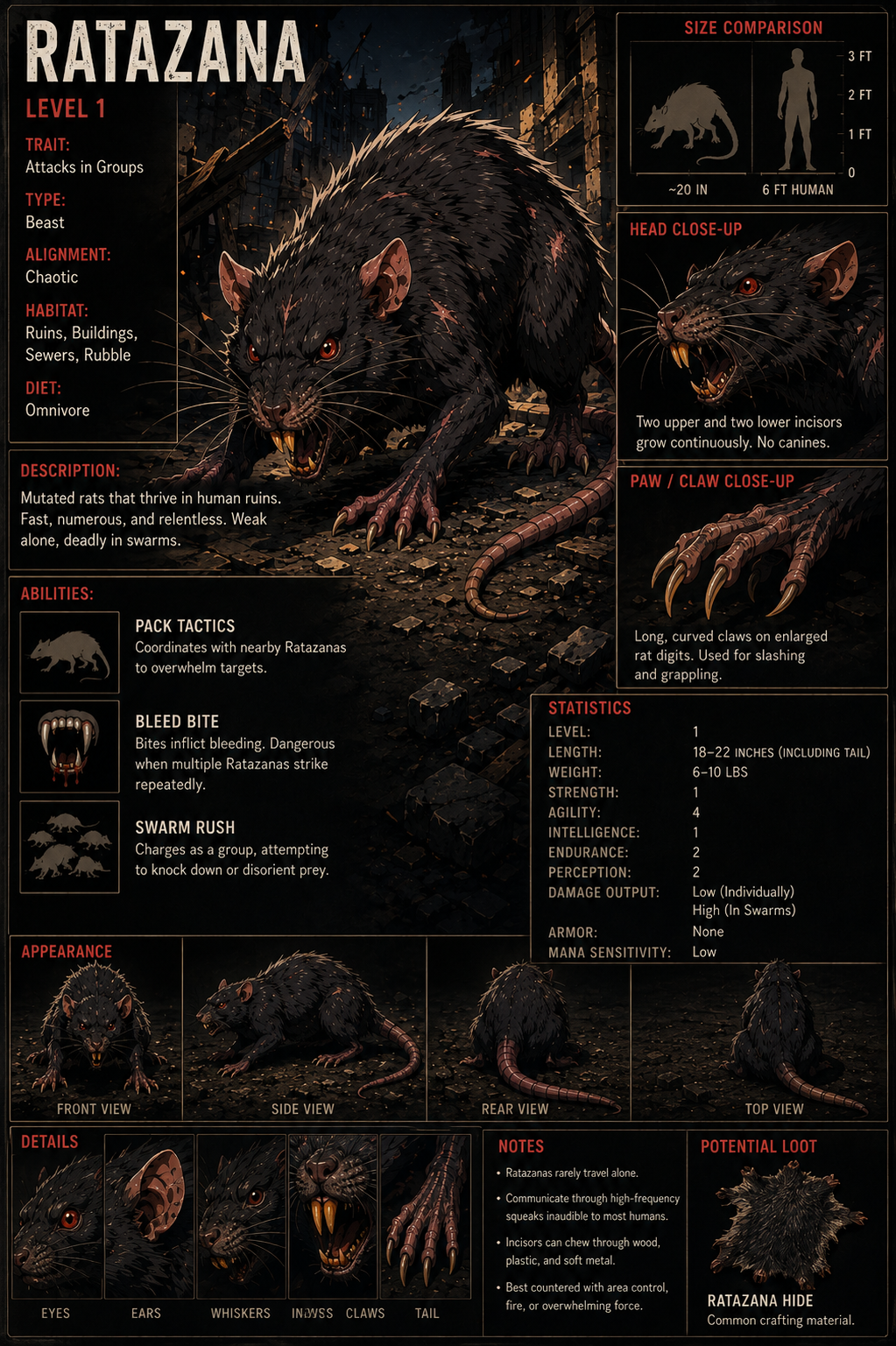
Level: 1
Type: Beast
Classification: Swarm Creature
Nature: Biological / MANA-Augmented
Alignment: Chaotic
Status: Active
Threat Level: Low Individually / Moderate to High in Groups
One is a pest.
Fifty is a problem.
Overview
Ratazanas are enlarged, MANA-augmented rats commonly found in abandoned buildings, ruined urban areas, warehouses, sewers, and locations containing accessible food or shelter.
Unlike many creatures appearing after Tuesday, Ratazanas retain the recognizable anatomy of ordinary rats.
They possess no unnatural fangs.
No glowing eyes.
No exposed muscle.
No significant physical mutations beyond their increased size, strength, aggression, and coordinated behavior.
An individual Ratazana presents only a limited threat to an armed survivor.
A group can overwhelm a target through speed, numbers, and attacks from multiple directions.
Ratazanas rarely travel alone.
Appearance
Ratazanas resemble unusually large black or dark-gray rats.
Their bodies retain natural rodent proportions and remain low to the ground. Their fur is dry, coarse, and dense, providing limited protection against environmental conditions.
Known characteristics include:
- Dry black or dark-gray fur
- Heavy but biologically recognizable rat body
- Small rounded ears
- Dark eyes
- Long whiskers
- Narrow rodent muzzle
- Two upper incisors
- Two lower incisors
- Orange or yellow enamel covering the front of the incisors
- Small forepaws with natural claws
- Powerful rear legs
- Long hairless tail covered in visible scales
- Occasional scars or small damaged patches of fur
Ratazanas do not possess canine teeth.
Their incisors grow continuously and are capable of cutting through wood, plastic, electrical wiring, thin metal, bone, and flesh.
Size
Total Length: 18–22 inches, including tail
Estimated Weight: 6–10 pounds
Movement: Quadrupedal
Body Structure: Natural Rodent Anatomy
Although significantly larger and heavier than most ordinary rats, Ratazanas remain small enough to move beneath shelves, vehicles, damaged structures, and narrow openings.
Their size allows them to remain difficult targets while increasing the damage caused by their bites.
MANA Profile
MANA: Metaphysical Augmentation through Natural Aether
MANA Density: Low
Primary Expression: Biological Augmentation
Secondary Expressions: Coordination, Agility
Observed Behavior: Aggressive / Opportunistic / Group-Oriented
MANA appears to augment existing biological characteristics rather than significantly restructuring the animal.
Observed enhancements may include:
- Increased body size
- Increased speed
- Increased bite strength
- Increased endurance
- Increased aggression
- Improved group coordination
- Increased resistance to disease and environmental hazards
The Ratazana may represent one of the simplest examples of MANA augmentation observed after Tuesday.
The animal remains biologically recognizable.
Its natural traits have simply become more dangerous.
Known System Information
Ratazana
Level: 1
Trait: Attacks in Groups
Additional information may become available through observation, research, combat, increased levels, or expanded System access.
Estimated Attributes
| Attribute | Rating | |---|---:| | Strength | 1 | | Agility | 4 | | Intelligence | 1 | | Endurance | 2 | | Perception | 2 | | Armor | None | | MANA Sensitivity | Low |
Traits
Attacks in Groups
Ratazanas rarely engage targets individually.
When threatened—or directed toward prey—they coordinate with nearby members of the group and attack from multiple directions.
Common behaviors include:
- Surrounding isolated targets
- Attacking exposed legs
- Moving beneath obstacles
- Climbing shelves and damaged structures
- Leaping from elevated positions
- Distracting targets from the front
- Attacking from behind while attention is divided
- Continuing forward despite casualties
The effectiveness of a Ratazana group increases rapidly as additional creatures join the attack.
One Ratazana can be killed easily.
Ten can divide attention.
Fifty can overwhelm a defensive position.
Pack Coordination
Ratazanas communicate through vocalizations, scent, body movement, and high-frequency sounds that may be difficult for humans to detect.
Groups may react simultaneously to:
- Threats
- Food
- Injured members
- Territory
- Commands from larger creatures
- Unknown MANA signals
Their coordination should not necessarily be interpreted as human-level intelligence.
The behavior may be instinctive, enhanced through MANA, or directed by another creature.
Abilities
Swarm Rush
A group of Ratazanas charges a target simultaneously.
The attack prioritizes overwhelming defensive attention rather than individual damage.
Possible effects include:
- Knockdown
- Disorientation
- Restricted movement
- Loss of balance
- Multiple simultaneous bites
- Separation from nearby allies
Ratazanas may continue advancing despite significant group casualties.
Bleeding Bite
A Ratazana attacks using its enlarged incisors.
The bite may cause:
- Deep punctures
- Tearing injuries
- Bleeding
- Damage to fingers and exposed joints
- Damage to equipment
- Reduced mobility when directed toward the legs
Individual bites are generally survivable.
Repeated bites from multiple Ratazanas may become life-threatening.
Gnaw
Ratazana incisors are continuously growing and capable of damaging a variety of materials.
Observed or suspected targets include:
- Wood
- Plastic
- Electrical wiring
- Food containers
- Thin sheet metal
- Leather
- Bone
- Damaged protective equipment
Groups may gradually weaken barriers that would stop an individual creature.
Behavior
Ratazanas are opportunistic omnivores.
They may consume:
- Stored food
- Garbage
- Plants
- Insects
- Animal remains
- Human remains
- Injured creatures
- Other Ratazanas
They are attracted to locations containing food, water, shelter, warmth, or accumulated waste.
Ratazanas may establish large colonies inside abandoned human structures.
Potential nesting locations include:
- Warehouses
- Grocery stores
- Restaurants
- Apartment buildings
- Sewers
- Subway systems
- Hardware stores
- Industrial buildings
- Storm drains
- Collapsed structures
Group Behavior
Ratazanas may become significantly more aggressive when accompanied by a Ratling.
Observed behavioral changes may include:
- Reduced fear
- Increased coordination
- Increased willingness to attack armed targets
- Reduced response to casualties
- Coordinated retreat
- Protection of territory
- Defense of the Ratling
The exact relationship between Ratazanas and Ratlings remains unknown.
Strengths
- Fast
- Agile
- Difficult to target individually
- Capable of moving through small openings
- Effective in large groups
- Strong group coordination
- Able to attack from multiple directions
- Capable of damaging supplies and infrastructure
- Low individual fear response during a swarm
Weaknesses
Ratazanas possess no natural armor.
They remain vulnerable to:
- Conventional firearms
- Blunt-force trauma
- Cutting weapons
- Fire
- Explosions
- Area attacks
- Environmental barriers
- Sustained defensive formations
Their primary defense is numbers.
Separating an individual from the group significantly reduces the threat.
Combat Considerations
Ratazanas should not be treated as individual combatants when encountered in large numbers.
Recommended considerations include:
- Maintain group formation.
- Protect legs and exposed joints.
- Avoid becoming surrounded.
- Do not pursue individual creatures into confined spaces.
- Prioritize area control.
- Maintain clear fields of fire.
- Protect injured personnel.
- Watch elevated shelves and damaged structures.
- Expect attacks from beneath vehicles and equipment.
- Identify whether a Ratling is directing the group.
When possible, eliminate commanding or coordinating creatures first.
Potential Loot
Ratazana Hide
Classification: Common Crafting Material
Quality: Low
MANA Density: Low
Ratazana Hide consists of coarse fur and MANA-augmented skin recovered after the creature is defeated.
Potential uses may include:
- Insulation
- Clothing
- Leather components
- Equipment padding
- Basic crafting experiments
- MANA research
The material possesses limited durability compared with higher-level monster hides.
Its primary value may come from availability.
Large swarms can produce significant quantities.
Research Questions
- Were Ratazanas ordinary rats before Tuesday?
- Did MANA increase their size?
- Did the System create them in their current form?
- Why does the System identify them using the name Ratazana?
- Can Ratazanas gain levels?
- Can individual Ratazanas evolve into Ratlings?
- Are Ratlings leaders, evolved individuals, or a separate species?
- How do groups coordinate?
- Can humans detect their high-frequency communication?
- Does MANA connect members of a swarm?
- Can Ratlings directly command them?
- How large can a colony become?
- Do colonies possess additional higher-level forms?
Narrative Role
Ratazanas introduce a different type of threat.
The Canis Draco is dangerous because of its speed, strength, and individual lethality.
The Ratazana is dangerous because there is rarely only one.
Their appearance demonstrates that MANA does not always create entirely new organisms.
Sometimes it takes something humanity already knows and augments the traits that made it successful.
Rats survived alongside humanity for thousands of years.
After Tuesday, they became better at it.
Lore Notes
Ratazanas should remain visually recognizable as rats.
Their appearance should avoid unnecessary fantasy mutations.
They should not possess:
- Canine teeth
- Rows of predator fangs
- Glowing eyes
- Exposed muscle
- Demonic horns
- Undead decay
- Constantly wet fur
- Humanoid anatomy
Their horror comes from familiarity.
A survivor immediately recognizes the animal.
Then they recognize its size.
Then they hear dozens more moving beneath the shelves.
Quote
Something moved beneath the shelf.
Then another shape crossed the aisle.
Darius raised the shotgun.
“Are those rats?”
Jose leaned closer.
“Rats? Those things are bigger than my cat.”
Clive looked toward him.
“You have a cat?”
“That is what you got from this?”
The first Ratazana stepped beneath the flickering light.
Then the floor behind it began to move.
